
Entry in What Coverage a Teen Driver Needs
Dropping Collision and Comprehensive for a Teen Driver: The 10x Rule
Find out when dropping collision and comprehensive coverage on an older vehicle driven by a teenager makes financial sense using the 10x premium rule.

By Samuel Oduya · Staff Writer
Published
Answer in brief
Deciding whether to drop collision and comprehensive coverage on a teenager's car depends on vehicle value, premium costs, and crash probability. The Insurance Information Institute recommends considering dropping physical damage coverage when the annual premium exceeds 10% of the vehicle's market value. Because 16- and 17-year-olds carry the highest crash risk among all motorists, families must balance premium savings against the out-of-pocket cost of replacing the vehicle if an at-fault crash occurs.
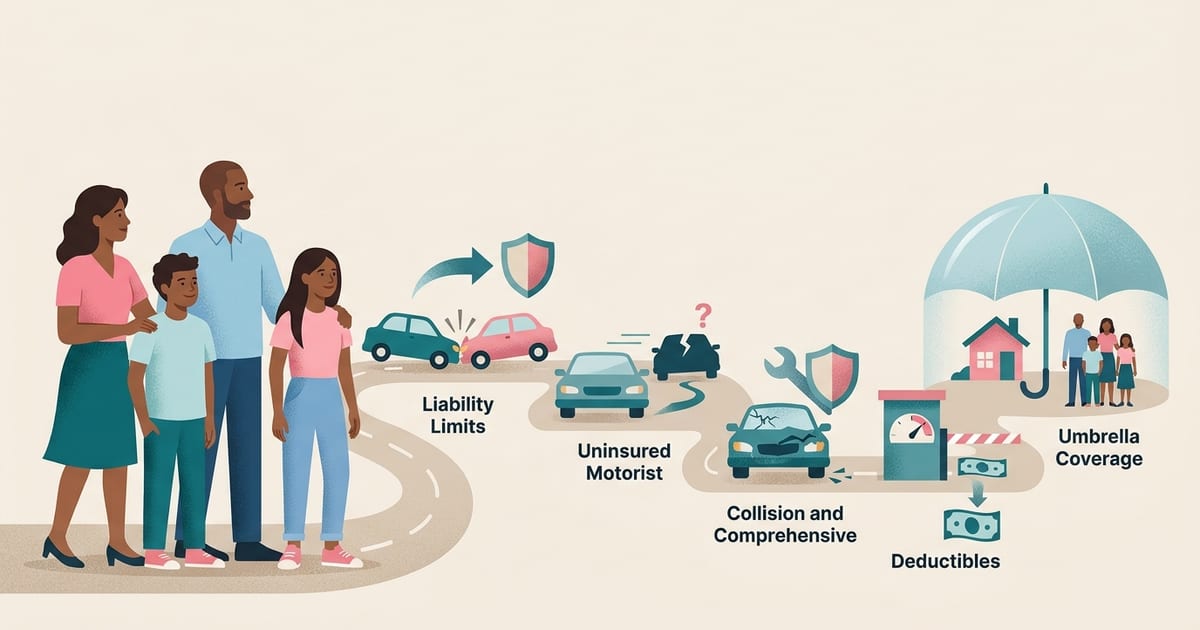
Physical Damage Coverage on a Teen Driver's Vehicle
When adding a young driver to an auto policy, collision and comprehensive coverages often account for a substantial portion of the total rate increase. Collision coverage pays for physical damage to your vehicle resulting from an impact with another automobile or stationary object, or from an upset or rollover. Comprehensive coverage pays for vehicle damage caused by non-collision events, including theft, vandalism, fire, hail, fallen tree branches, and collisions with animals.
Because drivers aged 16 to 19 have an all-severity crash rate over four times higher than drivers aged 20 and older according to the Insurance Institute for Highway Safety, insurers assign high physical damage rates to vehicles operated by teenagers. When an older, depreciated car is assigned to a teen, parents frequently face a difficult decision: continue paying high physical damage premiums or drop collision and comprehensive to retain only mandatory liability coverages.
The 10x Rule for Auto Physical Damage Premiums
To determine whether physical damage coverage remains cost-effective, consumer finance experts and the Insurance Information Institute suggest using the 10x rule: if the combined annual cost of collision and comprehensive insurance exceeds 10% of the vehicle's actual cash value (meaning the car is worth less than 10 times the annual physical damage premium), dropping physical damage coverage is generally worth considering.
| Vehicle Cash Value | Illustrative Annual Collision + Comp Cost | Ratio of Value to Premium | Coverage Recommendation |
|---|---|---|---|
| $2,500 | $800 | 3.1x (Value is under 10x premium) | Drop coverage; set aside savings for vehicle replacement |
| $4,000 | $650 | 6.2x (Value is under 10x premium) | Consider dropping, especially with high deductibles |
| $8,000 | $700 | 11.4x (Value exceeds 10x premium) | Maintain coverage; consider raising deductible |
| $15,000 | $950 | 15.8x (Value exceeds 10x premium) | Maintain coverage to protect substantial vehicle equity |
In the event of a total loss, an insurer will pay only the actual cash value of the vehicle minus your deductible. If a car is worth $3,000 and carries a $1,000 deductible, the maximum net payout following a severe crash is $2,000. Paying $800 annually for a theoretical maximum recovery of $2,000 represents poor risk transfer for most household budgets.
Alternative Strategy: Raising Deductibles to Maintain Protection
Families who are reluctant to drop physical damage coverage entirely can capture meaningful savings by restructuring their deductibles. The Insurance Information Institute points out that increasing a comprehensive and collision deductible from $200 to $500 can reduce the physical damage portion of your premium by 15% to 30%. Elevating the deductible further to $1,000 can reduce that premium segment by 40% or more.
This deductible strategy allows parents to maintain a financial safety net against major catastrophic losses—such as total vehicle theft or complete loss from a severe collision—while cutting the ongoing premium burden. The practical requirement is ensuring that the household maintains sufficient liquid savings to cover the chosen out-of-pocket deductible in the event of an at-fault accident.
Uninsured Motorist Exposure and Physical Damage Risks
Before removing collision coverage, consider the risk of accidents caused by uninsured drivers. Insurance Research Council data published by the Insurance Information Institute indicates substantial rates of uninsured motorists across several states, including 28.2% in Mississippi, 22.3% in Michigan, 20.6% in Florida, 20.4% in California, and 14.5% in Texas.
If an uninsured driver hits your teen's car, collision coverage pays for your vehicle repairs regardless of fault. If you drop collision and lack specific uninsured motorist property damage coverage in a state where it is offered, you must pay all vehicle repair costs out of pocket unless you successfully recover damages through civil litigation. Highway Loss Data Institute loss analyses indicate that claim frequency and severity vary significantly by vehicle type, meaning vehicle durability and local uninsured motorist density should both inform your coverage decision.
Step-by-Step Decision Process for Teen Vehicle Coverage
- 1
Establish the vehicle's fair market value
Determine the current private-party cash value using reputable valuation guides based on mileage, condition, and equipment.
- 2
Examine your policy declarations page
Isolate the exact annual dollar premium charged specifically for collision and comprehensive on that specific vehicle.
- 3
Subtract your deductible from the market value
Calculate your true maximum net payout by subtracting your current deductible from the car's estimated actual cash value.
- 4
Assess emergency replacement savings
Confirm whether your household could comfortably replace the car or manage without it if an uncompensated total loss occurs.
While dropping collision and comprehensive can provide budget relief, never reduce your liability limits to state minimums. Every state requires motorists to maintain proof of financial responsibility, but state minimum limits serve only as a baseline and rarely cover the catastrophic costs of severe multi-vehicle crashes involving teen drivers.
Questions & answers
Can I keep comprehensive coverage while dropping collision coverage?
Yes. Most insurers permit policyholders to retain comprehensive coverage while removing collision. Comprehensive coverage is generally much less expensive than collision and protects against animal impacts, storm damage, fire, and vehicle theft.
Does dropping collision affect my liability coverage?
No. Collision and comprehensive cover physical damage to your own vehicle. Dropping them has no impact on bodily injury liability, property damage liability, or uninsured motorist coverages, which protect against claims made by others.
What is the 10x rule in auto insurance?
The 10x rule is a financial guideline suggesting that if the annual premium for collision and comprehensive coverage exceeds 10% of the vehicle's market value (meaning the car is worth less than 10 times the annual physical damage premium), dropping physical damage coverage may be financially advantageous.
Will my insurer pay full market value if an older car is totaled?
No. Insurers pay the vehicle's actual cash value immediately prior to the crash, minus your policy deductible. They will not reimburse the original purchase price or exceed current market replacement value.
Terms: Collision coverage, Comprehensive coverage, Deductible, At-fault accident, Liability limits
Sources and references
Legal figures on this page (minimum limits, filing periods, statutory benefits) are checked against the primary law or the state insurance regulator listed below. Links and figures last verified Nov 2026.
- 14 percent of U.S. drivers were uninsured in 2022 — Insurance Research Council (2023)Independent researchAbout one in seven drivers was uninsured in 2022; highest D.C. 25.2%, New Mexico 24.9%, Mississippi 22.2%; lowest Wyoming 5.9%, Maine 6.2%, Idaho 6.2%. Method: ratio of UM to BI claim frequencies.
- Fatality facts: Teenagers — Insurance Institute for Highway Safety (2024)Statistical dataFatal crash rate per mile driven for 16–19-year-olds is just over 3 times the rate for drivers 20 and older (2022 travel data); all-severity crash rate is over 4 times; risk is highest at 16–17.
- Estimated percentage of uninsured motorists by state, 2017–2023 — Insurance Information Institute (2025)Statistical dataIRC time series by state; 2023: Mississippi 28.2%, New Mexico 24.1%, D.C. 23.1%, Michigan 22.3%, Florida 20.6%, California 20.4%, Texas 14.5%; lowest Maine 5.7%.
- Insurance losses by make and model — Highway Loss Data InstituteStatistical dataRelative claim frequency and severity by vehicle under collision, property damage, comprehensive, PIP, MedPay and bodily injury coverages.
- Nine ways to lower your auto insurance costs — Insurance Information InstituteConsumer guidanceShop at least three quotes; raising a deductible from $200 to $500 can cut collision/comprehensive cost 15–30%, $1,000 can save 40%+; drop physical damage on cars worth under 10× the premium; bundling, low-mileage and good-student discounts.
- What is covered by a basic auto insurance policy? — Insurance Information InstituteConsumer guidanceDefines bodily injury and property damage liability, MedPay, PIP, uninsured/underinsured motorist, collision, comprehensive and glass coverage.
- How much auto coverage do I need? — Insurance Information InstituteConsumer guidanceWhy state minimums are a floor; choosing liability limits that protect assets; when collision and comprehensive are worth keeping.
- Is it legal to drive without insurance? — Insurance Information InstituteConsumer guidanceEvery state requires drivers to demonstrate financial responsibility; in most states insurance is the mandatory way to do so.
Practical guidance on this page is original editorial work. Cited sources support factual statements and do not endorse this site. Dollar ranges described as typical or illustrative are editorial estimates, not figures from these sources.
Entry
Umbrella Insurance for Teen Drivers: Why Higher Liability Limits Matter
Discover why adding a teen driver creates serious liability risks, how umbrella insurance works, and how to protect family assets from severe crash claims.
Parent guide
What Coverage a Teen Driver Needs
Liability limits, uninsured motorist, collision and comprehensive, deductibles and umbrella coverage for a family with a teen driver.