
Guide
How Much It Costs to Insure a Teen Driver
What adding a 16- or 17-year-old does to a family premium, what a teen pays alone, why teens are the most expensive drivers to insure, and how the cost falls.

By Laura Jensen · Editor
Published · Updated
Answer in brief
Adding a newly licensed 16-year-old to a family policy typically increases the premium by $1,800–$3,200 a year; a 17-year-old slightly less. A teen on a separate policy commonly pays $4,500–$7,000. Teens are the most expensive drivers to insure because 16- and 17-year-olds have the highest crash rates per mile of any age group—several times that of drivers in their thirties. The premium falls at each renewal and drops sharply at 19 and 21 with a clean record.
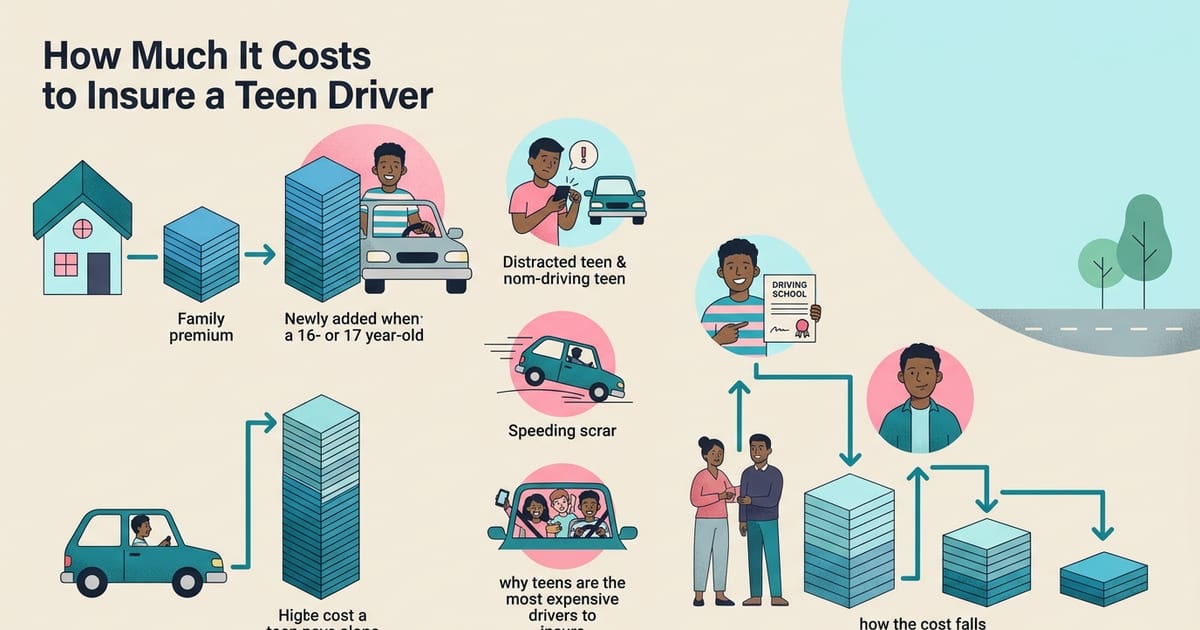
Typical cost of adding a teen
| Teen | Added to family policy | Separate policy |
|---|---|---|
| 16, newly licensed | +$1,800–$3,200 | $4,500–$7,000 |
| 17, one year licensed | +$1,600–$2,900 | $4,000–$6,200 |
| 17, with good student + telematics | +$1,200–$2,200 | $3,200–$5,000 |
| Urban ZIP code | Add 20–40% to the above | Add 20–40% |
Why teens cost the most
Highway-safety research is consistent: the crash rate per mile for 16–17-year-olds is roughly three times that of drivers 20 and older, and the first months after licensing are the riskiest of all. Night driving, passengers and inexperience with hazards all contribute. Insurers price the group average because an individual teen has no record yet.
What the family controls
- Which car the teen is assigned to—the insurer usually rates them on the vehicle they drive most.
- The vehicle itself—a mid-size sedan versus a sports coupe can be a $1,500 difference.
- Discounts—good student, driver training and telematics are designed for teens.
- Coverage structure—higher deductibles and reviewing collision on the teen's car.
- The insurer—companies disagree about teens more than any other group.
Quote finder
Find auto insurance quotes that fit your situation
How it falls
The inexperience factor steps down each year and is gone after three; age factors fall at 19, 21 and 25. A 16-year-old's share of the family premium typically halves by 19 with a clean record.
Questions & answers
How much does insurance go up when you add a 16-year-old?
Typically $1,800–$3,200 a year on a family policy.
Is it cheaper to add a teen or get them their own policy?
Adding them is almost always cheaper—by 40–60%.
Does it matter which car the teen drives?
Yes. The teen is usually rated on the car they drive most; assigning them to the lowest-value, safest car reduces the increase.
Terms used in this guide
- Youthful operator
- An insurer's term for a driver under about 25, rated with a youth factor in addition to any inexperience factor.
- Age band
- An age grouping with its own factor. Highest at 16–17; falls at 19, 21 and 25.
- Premium
- The price of a policy, per six or twelve months.
Sources and references
Legal figures on this page (minimum limits, filing periods, statutory benefits) are checked against the primary law or the state insurance regulator listed below. Links and figures last verified Nov 2026.
- Teenagers — Insurance Institute for Highway SafetyIndependent researchTeen crash risk, graduated driver licensing research and vehicle recommendations for young drivers.
- Graduated licensing laws by state — Insurance Institute for Highway SafetyIndependent researchState-by-state learner, intermediate and full-licence ages, night-driving and passenger restrictions.
- Facts + Statistics: Teen drivers — Insurance Information InstituteStatistical dataCrash and fatality statistics for drivers 16–19 and graduated licensing context.
- Fatality facts: Teenagers — Insurance Institute for Highway Safety (2024)Statistical dataFatal crash rate per mile driven for 16–19-year-olds is just over 3 times the rate for drivers 20 and older (2022 travel data); all-severity crash rate is over 4 times; risk is highest at 16–17.
- Drivers in fatal motor vehicle crashes by age, 2023 — Insurance Information Institute (2025)Statistical dataFatal-crash involvement per 100,000 licensed drivers: 42.40 (16–20), 35.34 (21–24), 28.97 (25–34), 24.18 (35–44), 21.70 (45–54), 19.45 (55–64), 15.44 (65–74), 16.63 (75+).
- 2019–2023 Auto Insurance Database: average premium supplement — National Association of Insurance Commissioners (2025)Statistical dataCountrywide average expenditure $1,281 in 2023 (+13.98%); combined average premium $1,438; state tables for liability, collision and comprehensive.
- What determines the price of an auto insurance policy? — Insurance Information InstituteConsumer guidanceRating factors: driving record, mileage, location, age, gender, vehicle, credit-based insurance score, coverage choices. Notes ZIP-code rating is prohibited in California and Michigan and gender rating is prohibited in seven states.
- Auto insurance for teen drivers — Insurance Information InstituteConsumer guidanceAdding a teen to a parent's policy versus a separate policy; good-student and driver-training discounts; vehicle choice.
Practical guidance on this page is original editorial work. Cited sources support factual statements and do not endorse this site. Dollar ranges described as typical or illustrative are editorial estimates, not figures from these sources.
Guide
Adding a Teen Driver to Your Car Insurance
When you must add a teen, how permits are handled, how insurers assign teens to vehicles, named-driver exclusions, and the questions to ask your insurer.
Guide
Car Insurance Discounts for Teen Drivers
Good student, driver training, telematics, distant student and other discounts that specifically offset a teen's premium—with realistic ranges and requirements.
Guide
Best Cars for Teen Drivers to Insure
What makes a car cheap or expensive to insure for a teen—size, horsepower, crash ratings, repair cost, theft—and the profile safety researchers recommend.