
Entry in What Coverage a Teen Driver Needs
Umbrella Insurance for Teen Drivers: Why Higher Liability Limits Matter
Discover why adding a teen driver creates serious liability risks, how umbrella insurance works, and how to protect family assets from severe crash claims.

By Samuel Oduya · Staff Writer
Published
Answer in brief
Adding a newly licensed teenager to your household substantially increases the risk of severe collisions that can exceed baseline auto liability limits. An umbrella insurance policy provides a secondary layer of protection above your standard auto limits, safeguarding family homes, savings, and future earnings against catastrophic judgment awards. Reviewing asset exposure and maintaining required underlying limits ensures robust financial protection.
The Heightened Liability Exposure of Teen Drivers
When a teenager begins driving independently, a family's liability exposure expands dramatically. Data compiled by the Insurance Institute for Highway Safety reveals that the fatal crash rate per mile traveled for drivers aged 16 to 19 is just over three times higher than for drivers aged 20 and older, with the all-severity crash rate exceeding four times that of older drivers. Furthermore, crash data shows fatal-crash involvement per 100,000 licensed drivers reaches 42.40 for motorists aged 16 to 20, compared to 24.18 for drivers aged 35 to 44.
Because teen drivers lack critical road experience, collisions involving young operators frequently result in severe bodily injury or multi-vehicle property damage. In serious accidents where medical treatment, prolonged hospitalization, or lifelong rehabilitation is necessary, damages easily surpass standard baseline auto liability limits. If third-party claims exceed your policy cap, parents are held personally liable for the remaining balance.
How Personal Umbrella Policies Work with Auto Coverage
An umbrella policy operates as supplemental liability protection that sits directly on top of your primary auto and homeowners policies. It does not replace your standard auto coverage; rather, it activates only after your underlying auto liability limits have been completely exhausted by a catastrophic claim.
Standard personal umbrella policies are typically sold in increments of $1 million, extending up to $5 million or more. According to the National Association of Insurance Commissioners, the countrywide average expenditure for standard auto coverage was $1,281 in 2023. By comparison, a $1 million umbrella policy often costs between $200 and $400 annually, though premiums increase modestly when a youthful operator is added to the household.
| Claim Scenario | Auto Policy Only ($300k Limit) | Auto + $1M Umbrella Policy | Family Out-of-Pocket Liability |
|---|---|---|---|
| Severe Crash with $250,000 in Bodily Injury | Auto policy pays $250,000 in full | Auto policy pays $250,000; umbrella not needed | $0 out-of-pocket |
| Multi-Car Crash with $650,000 in Bodily Injury | Auto policy pays $300,000 cap; $350,000 unpaid | Auto policy pays $300,000; umbrella pays $350,000 | $350,000 without umbrella vs. $0 with umbrella |
| Catastrophic Crash with $1,200,000 Judgement | Auto policy pays $300,000 cap; $900,000 unpaid | Auto pays $300,000; umbrella pays $900,000 | $900,000 without umbrella vs. $0 with umbrella |
Underlying Liability Requirements for Umbrella Eligibility
Insurers generally do not sell umbrella coverage over bare-minimum auto policies. Instead, underwriters mandate specific underlying liability limits on all active vehicles in the household before an umbrella contract can be issued.
Common carrier requirements mandate primary auto limits of at least $250,000 or $300,000 for bodily injury per person, $500,000 for bodily injury per accident, and $100,000 for property damage liability. If your current auto insurance policy carries lower limits, you must first pay the additional premium to step up your base policy before the umbrella carrier will bind excess coverage.
Assets at Risk in an At-Fault Teen Accident
Many parents mistakenly believe that their financial liability is limited to the value of the vehicle driven by the teen. However, when an at-fault accident occurs, injured third parties can pursue court judgments that target personal assets belonging to the vehicle owners and custodial parents, including:
- Home Equity: While state homestead exemptions provide varying degrees of real estate protection, substantial equity in primary or secondary residences can be vulnerable to judgment liens.
- Liquid Savings and Investments: Non-retirement brokerage accounts, mutual funds, certificates of deposit, and personal savings are fully reachable to satisfy liability judgments.
- Future Wages: Courts can enter wage garnishment orders that attach to a parent's earnings for years until a judgment is satisfied.
- Legal Defense Costs: Umbrella policies provide independent legal defense coverage beyond the limits of your underlying auto policy, covering attorney retainers and litigation costs that mount rapidly during complex crash lawsuits.
How Parents Can Secure Umbrella Coverage Efficiently
- 1
Inventory Your Total Household Net Worth
Calculate your combined home equity, bank deposits, non-qualified investment accounts, and future earning potential to identify the appropriate umbrella limit ($1 million to $5 million).
- 2
Adjust Underlying Auto and Home Limits
Review your auto declarations page and raise your primary bodily injury and property damage limits to satisfy the minimum thresholds required by umbrella underwriters.
- 3
Bundle Policies with a Single Carrier
Most insurers offer lower premiums and smoother claim handling when your auto, homeowners, and personal umbrella policies are issued by the same underwriting group.
- 4
Enforce Household Safe Driving Rules
Combine elevated liability coverage with preventive measures, such as monitoring speed and compliance with graduated driver licensing restrictions, to minimize crash risks.
Questions & answers
Does my personal umbrella policy automatically cover my teen driver?
Yes, provided your teen driver is formally listed as a resident driver on your primary auto policy and your underlying auto liability limits satisfy the minimum threshold required by your umbrella insurer.
How much does umbrella insurance cost when adding a teenage driver?
While a standalone umbrella policy without young drivers typically costs $200 to $350 annually for $1 million in coverage, adding a youthful operator usually raises the umbrella premium to an illustrative range of $350 to $600 per year.
What happens if my auto limits are lower than what the umbrella policy requires?
If an accident occurs and your underlying auto policy limits fall short of the required threshold (for example, you carry $100,000 but the umbrella mandates $300,000), the umbrella policy will only pay for damages exceeding the required $300,000. You remain personally responsible for the $200,000 coverage gap.
Is $1 million in umbrella coverage enough for a family with a teen driver?
For many households, a $1 million umbrella policy offers substantial protection. However, families with high net worth, valuable home equity, or multiple young drivers often opt for $2 million to $5 million in coverage, which costs only incrementally more.
Terms: Umbrella policy, Liability limits, At-fault accident, Youthful operator
Sources and references
Legal figures on this page (minimum limits, filing periods, statutory benefits) are checked against the primary law or the state insurance regulator listed below. Links and figures last verified Nov 2026.
- Fatality facts: Teenagers — Insurance Institute for Highway Safety (2024)Statistical dataFatal crash rate per mile driven for 16–19-year-olds is just over 3 times the rate for drivers 20 and older (2022 travel data); all-severity crash rate is over 4 times; risk is highest at 16–17.
- Drivers in fatal motor vehicle crashes by age, 2023 — Insurance Information Institute (2025)Statistical dataFatal-crash involvement per 100,000 licensed drivers: 42.40 (16–20), 35.34 (21–24), 28.97 (25–34), 24.18 (35–44), 21.70 (45–54), 19.45 (55–64), 15.44 (65–74), 16.63 (75+).
- 2019–2023 Auto Insurance Database: average premium supplement — National Association of Insurance Commissioners (2025)Statistical dataCountrywide average expenditure $1,281 in 2023 (+13.98%); combined average premium $1,438; state tables for liability, collision and comprehensive.
- Automobile financial responsibility limits by state — Insurance Information Institute (2023)Statistical dataCompulsory coverages and minimum liability limits by state (table dated December 2023 — several states have raised limits since; see statute entries).
- How much auto coverage do I need? — Insurance Information InstituteConsumer guidanceWhy state minimums are a floor; choosing liability limits that protect assets; when collision and comprehensive are worth keeping.
- What is covered by a basic auto insurance policy? — Insurance Information InstituteConsumer guidanceDefines bodily injury and property damage liability, MedPay, PIP, uninsured/underinsured motorist, collision, comprehensive and glass coverage.
- Nine ways to lower your auto insurance costs — Insurance Information InstituteConsumer guidanceShop at least three quotes; raising a deductible from $200 to $500 can cut collision/comprehensive cost 15–30%, $1,000 can save 40%+; drop physical damage on cars worth under 10× the premium; bundling, low-mileage and good-student discounts.
- Is it legal to drive without insurance? — Insurance Information InstituteConsumer guidanceEvery state requires drivers to demonstrate financial responsibility; in most states insurance is the mandatory way to do so.
Practical guidance on this page is original editorial work. Cited sources support factual statements and do not endorse this site. Dollar ranges described as typical or illustrative are editorial estimates, not figures from these sources.
Entry
Dropping Collision and Comprehensive for a Teen Driver: The 10x Rule
Find out when dropping collision and comprehensive coverage on an older vehicle driven by a teenager makes financial sense using the 10x premium rule.
Parent guide
What Coverage a Teen Driver Needs
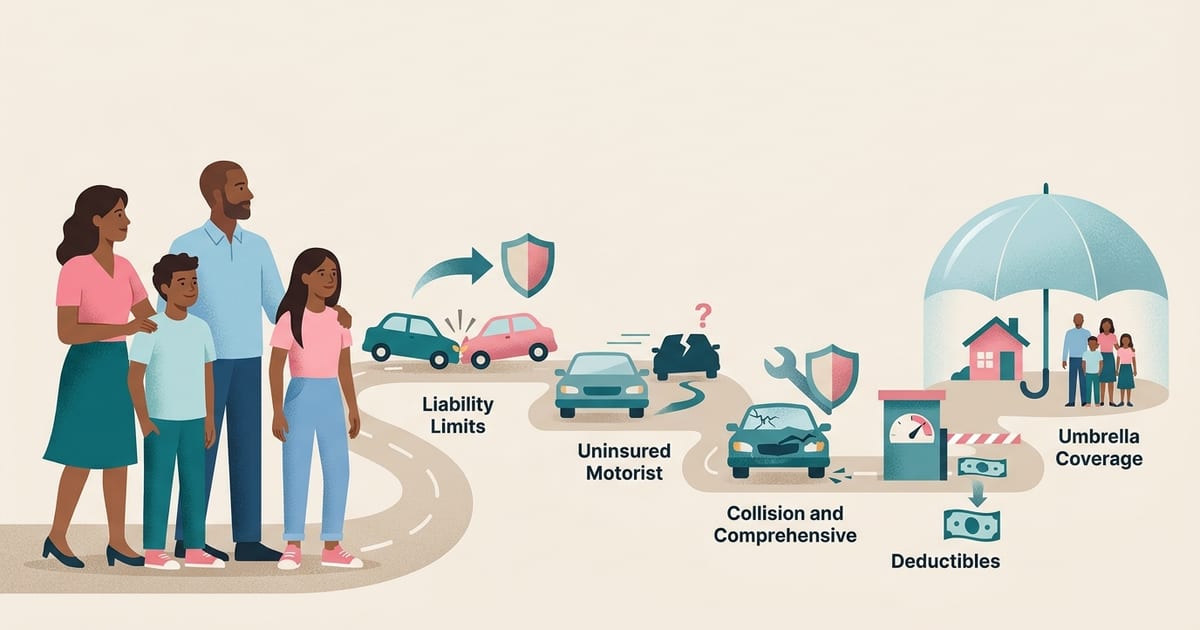
Liability limits, uninsured motorist, collision and comprehensive, deductibles and umbrella coverage for a family with a teen driver.