
Guide
What Coverage a Teen Driver Needs
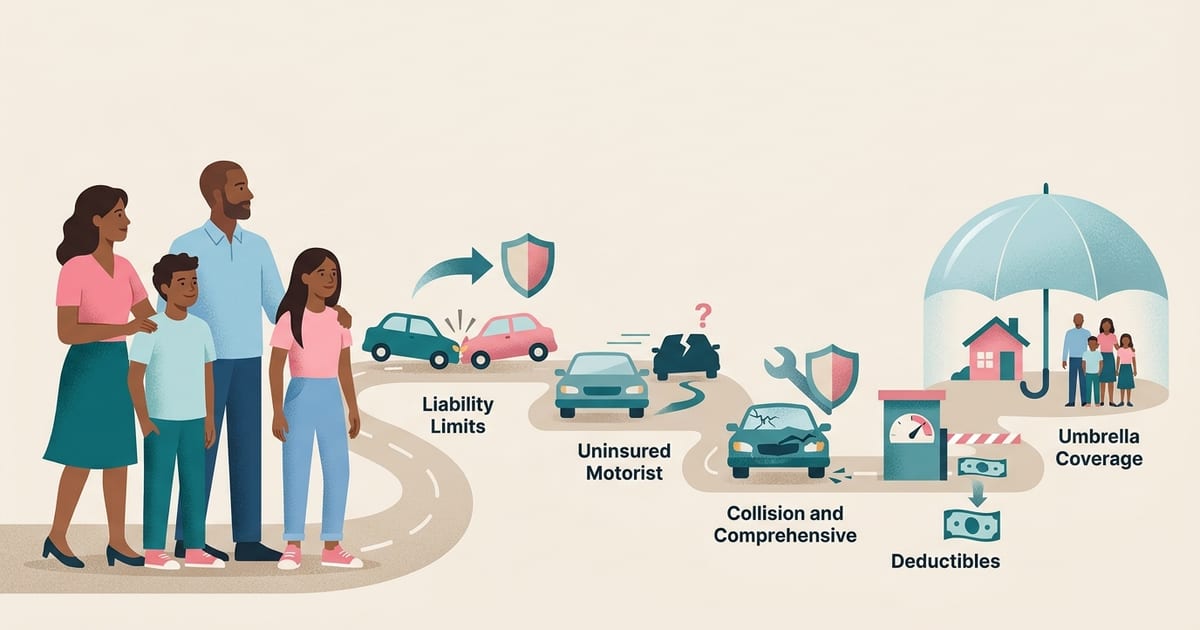
Liability limits, uninsured motorist, collision and comprehensive, deductibles and umbrella coverage for a family with a teen driver.

By Samuel Oduya · Staff Writer
Published · Updated
Answer in brief
A teen driver raises the probability of an at-fault crash, which makes liability limits the first decision—most families should carry 100/300/100 or more, because the household's assets stand behind the teen's driving. Add uninsured motorist at the same limits. Collision and comprehensive belong on the teen's car if it is financed or worth more than about $5,000, with a $1,000 deductible. Families with meaningful assets often add an umbrella policy when a teen is licensed.
Why liability comes first
Parents are typically liable for a minor's driving, and the family policy is what pays. A serious injury claim can run well past $100,000. Raising limits from 50/100 to 100/300 typically adds 10–20% to the liability portion; raising to 250/500 and adding an umbrella adds a few hundred dollars for a million or more in protection.
The teen's car
Collision on a $4,000 car for a 16-year-old can cost $1,200 a year—more than a quarter of the car's value. Many families carry liability and comprehensive only on an older teen car and keep an emergency reserve instead. On a $12,000 car, keep collision with a $1,000 deductible.
Accident forgiveness
Where available, ask for it before the teen's first year. It typically protects one at-fault accident and must already be on the policy.
Entries in this guide
Specific questions answered in more depth.
Entry
Umbrella Insurance for Teen Drivers: Why Higher Liability Limits Matter
Discover why adding a teen driver creates serious liability risks, how umbrella insurance works, and how to protect family assets from severe crash claims.
Entry
Dropping Collision and Comprehensive for a Teen Driver: The 10x Rule
Find out when dropping collision and comprehensive coverage on an older vehicle driven by a teenager makes financial sense using the 10x premium rule.
Questions & answers
Should I raise my liability limits when my teen is licensed?
Yes, if you are below 100/300. The household's assets are exposed to the teen's driving.
Does my teen's car need full coverage?
If financed or worth more than about $5,000, usually yes. On a cheaper car, liability plus comprehensive is often the better trade.
Is an umbrella policy worth it with a teen driver?
For households with home equity or savings, a $1M umbrella for a few hundred dollars a year is widely recommended.
Terms used in this guide
- Liability limits
- The maximum the policy pays for injuries and damage caused to others, e.g. 100/300/100 in thousands.
- Umbrella policy
- Extra liability coverage of $1 million or more above auto and home limits. Commonly added when a teen is licensed.
- Deductible
- What you pay before collision or comprehensive pays. $1,000 is the usual choice when a teen is added.
- Uninsured/underinsured motorist coverage
- Pays for your family's injuries when the at-fault driver has no or too little insurance.
Sources and references
Legal figures on this page (minimum limits, filing periods, statutory benefits) are checked against the primary law or the state insurance regulator listed below. Links and figures last verified Nov 2026.
- Teenagers — Insurance Institute for Highway SafetyIndependent researchTeen crash risk, graduated driver licensing research and vehicle recommendations for young drivers.
- Graduated licensing laws by state — Insurance Institute for Highway SafetyIndependent researchState-by-state learner, intermediate and full-licence ages, night-driving and passenger restrictions.
- Facts + Statistics: Uninsured motorists — Insurance Information Institute (2024)Statistical dataInsurance Research Council estimates of uninsured drivers by state (2022: e.g. Michigan 19.6%, California 17.0%, Florida 15.9%, Texas 13.8%).
- Automobile financial responsibility limits by state — Insurance Information Institute (2023)Statistical dataCompulsory coverages and minimum liability limits by state (table dated December 2023 — several states have raised limits since; see statute entries).
- Fatality facts: Teenagers — Insurance Institute for Highway Safety (2024)Statistical dataFatal crash rate per mile driven for 16–19-year-olds is just over 3 times the rate for drivers 20 and older (2022 travel data); all-severity crash rate is over 4 times; risk is highest at 16–17.
- What is covered by a basic auto insurance policy? — Insurance Information InstituteConsumer guidanceDefines bodily injury and property damage liability, MedPay, PIP, uninsured/underinsured motorist, collision, comprehensive and glass coverage.
- How much auto coverage do I need? — Insurance Information InstituteConsumer guidanceWhy state minimums are a floor; choosing liability limits that protect assets; when collision and comprehensive are worth keeping.
- Is it legal to drive without insurance? — Insurance Information InstituteConsumer guidanceEvery state requires drivers to demonstrate financial responsibility; in most states insurance is the mandatory way to do so.
Practical guidance on this page is original editorial work. Cited sources support factual statements and do not endorse this site. Dollar ranges described as typical or illustrative are editorial estimates, not figures from these sources.
Guide
Best Cars for Teen Drivers to Insure
What makes a car cheap or expensive to insure for a teen—size, horsepower, crash ratings, repair cost, theft—and the profile safety researchers recommend.
Guide
How Much It Costs to Insure a Teen Driver
What adding a 16- or 17-year-old does to a family premium, what a teen pays alone, why teens are the most expensive drivers to insure, and how the cost falls.
Guide
Adding a Teen Driver to Your Car Insurance
When you must add a teen, how permits are handled, how insurers assign teens to vehicles, named-driver exclusions, and the questions to ask your insurer.