
Guide
Car Insurance Discounts for Teen Drivers
Good student, driver training, telematics, distant student and other discounts that specifically offset a teen's premium—with realistic ranges and requirements.

By Samuel Oduya · Staff Writer
Published · Updated
Answer in brief
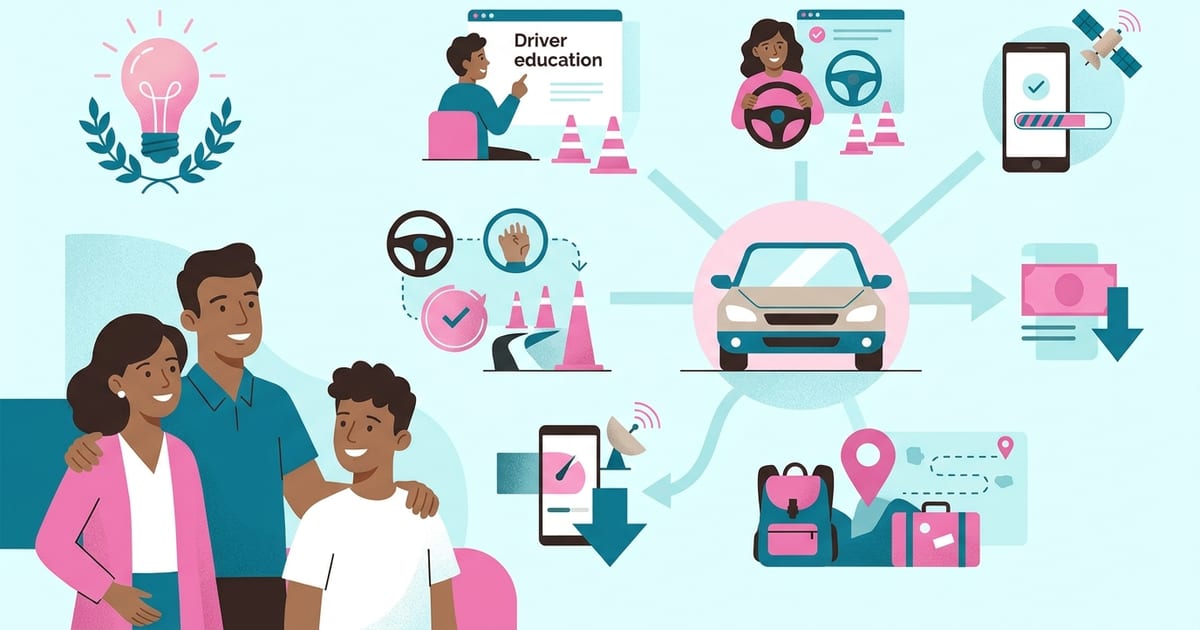
Teen-specific discounts can offset a meaningful share of the youth surcharge: good student (5–25% for a B average), driver training (5–15% for an approved course), telematics (5–30%, and the best fit for drivers with no record yet) and later the distant student discount when the teen leaves for college without a car. Family-level discounts—multi-car, bundling, pay in full—apply to the whole policy. Stacked, they commonly reduce the teen's addition by 20–35%.
| Discount | Typical range | Requirements |
|---|---|---|
| Telematics / teen safe-driver programme | 5–30% | App or device; smooth braking, limited night driving, no phone use |
| Good student | 5–25% | Full-time student, ~3.0 GPA or top 20%, transcript at enrolment and renewal |
| Driver training / driver's ed | 5–15% | Approved course certificate |
| Distant student (later) | 10–30% of teen's share | 100+ miles away at school without a car |
| Multi-car / bundling | 10–25% (policy-wide) | Family policy |
| Pay in full | 5–10% (policy-wide) | Upfront premium |
Telematics for teens
Several insurers run teen-specific programmes that score the teen's driving and report to parents. The behaviours that matter most—hard braking, late-night trips and phone handling—are exactly the ones a household rule can change. Programmes vary on whether poor scores can raise rates; ask before enrolling.
Good student
A B average or equivalent, verified by transcript, for full-time students—usually through age 24. Homeschooled teens typically qualify with standardised test scores.
Perspective
Discounts are worth claiming, but the insurer choice and the vehicle choice each move the teen's premium more than all the discounts combined. See cars and how to compare.
Entries in this guide
Specific questions answered in more depth.
Questions & answers
How much is the good student discount for teens?
Usually 5–25% of the teen's share of the premium.
Does driver's ed lower insurance?
Most insurers give 5–15% for an approved course; a few states require insurers to offer one.
Can telematics raise a teen's rate?
Some programmes can; many are discount-only. Ask before enrolling.
Terms used in this guide
- Good student discount
- Typically 5–25% for full-time students under 25 with about a B average.
- Telematics (usage-based insurance)
- Pricing based partly on measured driving via an app or device. Teen programmes often include parental reporting.
- Distant student discount
- A discount for a student 100+ miles from home without a car.
Sources and references
Legal figures on this page (minimum limits, filing periods, statutory benefits) are checked against the primary law or the state insurance regulator listed below. Links and figures last verified Nov 2026.
- Background on: Pay-as-you-drive auto insurance (telematics) — Insurance Information InstituteIndependent researchUsage-based and per-mile pricing models, what telematics programmes measure, and state limits on their use.
- Teenagers — Insurance Institute for Highway SafetyIndependent researchTeen crash risk, graduated driver licensing research and vehicle recommendations for young drivers.
- Graduated licensing laws by state — Insurance Institute for Highway SafetyIndependent researchState-by-state learner, intermediate and full-licence ages, night-driving and passenger restrictions.
- Facts + Statistics: Teen drivers — Insurance Information InstituteStatistical dataCrash and fatality statistics for drivers 16–19 and graduated licensing context.
- Fatality facts: Teenagers — Insurance Institute for Highway Safety (2024)Statistical dataFatal crash rate per mile driven for 16–19-year-olds is just over 3 times the rate for drivers 20 and older (2022 travel data); all-severity crash rate is over 4 times; risk is highest at 16–17.
- Nine ways to lower your auto insurance costs — Insurance Information InstituteConsumer guidanceShop at least three quotes; raising a deductible from $200 to $500 can cut collision/comprehensive cost 15–30%, $1,000 can save 40%+; drop physical damage on cars worth under 10× the premium; bundling, low-mileage and good-student discounts.
- What determines the price of an auto insurance policy? — Insurance Information InstituteConsumer guidanceRating factors: driving record, mileage, location, age, gender, vehicle, credit-based insurance score, coverage choices. Notes ZIP-code rating is prohibited in California and Michigan and gender rating is prohibited in seven states.
- Auto insurance for teen drivers — Insurance Information InstituteConsumer guidanceAdding a teen to a parent's policy versus a separate policy; good-student and driver-training discounts; vehicle choice.
Practical guidance on this page is original editorial work. Cited sources support factual statements and do not endorse this site. Dollar ranges described as typical or illustrative are editorial estimates, not figures from these sources.
Guide
How Much It Costs to Insure a Teen Driver
What adding a 16- or 17-year-old does to a family premium, what a teen pays alone, why teens are the most expensive drivers to insure, and how the cost falls.
Guide
Best Cars for Teen Drivers to Insure
What makes a car cheap or expensive to insure for a teen—size, horsepower, crash ratings, repair cost, theft—and the profile safety researchers recommend.
Guide
How to Compare Car Insurance With a Teen Driver
A comparison method for families adding a teen: fixed coverage, identical inputs, discounts applied consistently, three to five quotes, and the questions that reveal how an insurer treats teens.