
Guide
A Teen's First Accident or Ticket
What happens to a family premium after a teen's first at-fault accident or ticket, how long it lasts, accident forgiveness, and what to do.

By Laura Jensen · Editor
Published · Updated
Answer in brief
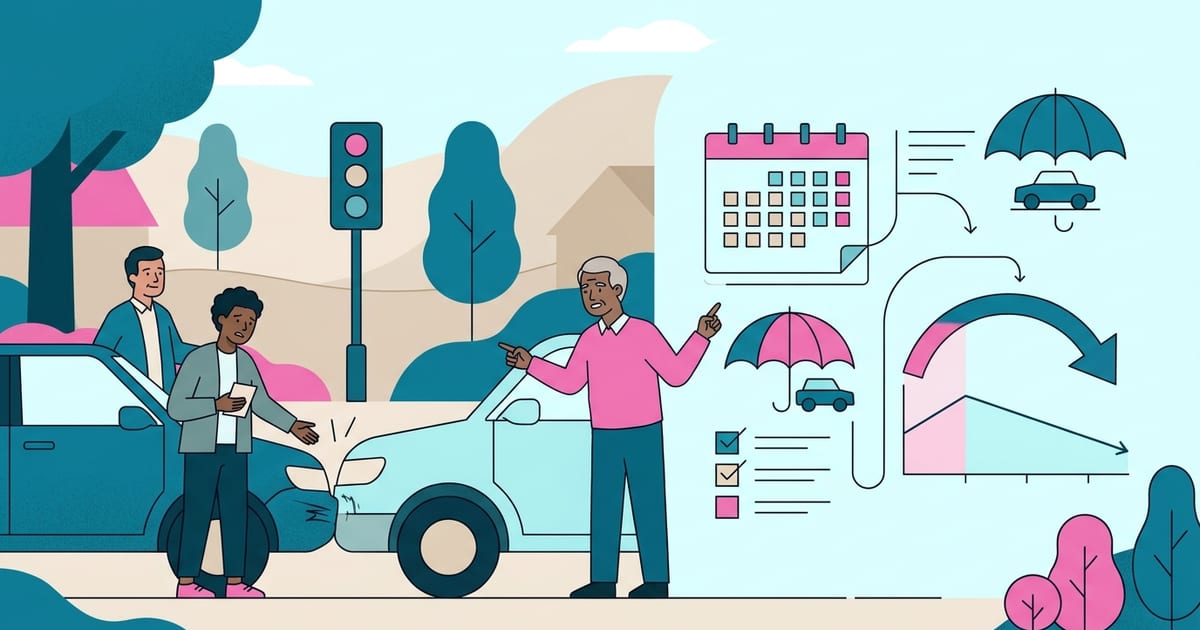
A teen's first at-fault accident typically raises their share of the premium by 30–60% for three years; a minor ticket adds 10–25%. Because the teen's base is already high, the dollar impact is large—often $800–$1,500 a year. Not-at-fault accidents usually carry no surcharge. Accident forgiveness, if already on the policy, can protect the first incident. Serious violations on an intermediate licence can also extend the licensing stage. The response: report honestly, consider a defensive-driving course, keep the record clean and compare at the next renewal.
Typical impact
| Incident | Typical increase to teen's share | Duration |
|---|---|---|
| Minor speeding ticket | 10–25% | 3 years |
| At-fault accident (claim paid) | 30–60% | 3 years |
| Major violation (reckless, 30+ over) | 50–100%; possible nonrenewal | 3–5 years |
| Not-at-fault accident | Usually none | — |
| Comprehensive claim (glass, theft) | Usually none | — |
Accident forgiveness
Available from some insurers as an add-on or earned benefit; prevents the first at-fault accident from raising the rate. It must be in place before the crash and usually applies once per policy. Ask about it when the teen is added.
What to do
- Report the accident promptly and accurately.
- Ask whether a defensive-driving course can remove points or earn a discount in your state.
- Keep the record clean—the surcharge expires in about three years.
- Compare insurers at the next renewal; surcharge sizes differ, and some companies are more tolerant of a single teen incident.
Questions & answers
How much will my rate go up after my teen's accident?
Typically 30–60% of the teen's share for three years.
Should I pay for minor damage out of pocket?
For damage close to the deductible with no injuries or other vehicle, paying yourself can avoid a surcharge. Report anything involving injuries or another party.
Will my insurer drop us after a teen's accident?
Rarely for a single accident. Two or more in a short period can trigger nonrenewal with some insurers.
Terms used in this guide
- Surcharge
- A percentage added for an at-fault accident or violation, typically for three years.
- Accident forgiveness
- A feature preventing a first at-fault accident from raising the rate; must be on the policy before the crash.
- At-fault accident
- A crash the insurer determines the driver caused. Surcharged; not-at-fault accidents usually are not.
Sources and references
Legal figures on this page (minimum limits, filing periods, statutory benefits) are checked against the primary law or the state insurance regulator listed below. Links and figures last verified Nov 2026.
- Teenagers — Insurance Institute for Highway SafetyIndependent researchTeen crash risk, graduated driver licensing research and vehicle recommendations for young drivers.
- Graduated licensing laws by state — Insurance Institute for Highway SafetyIndependent researchState-by-state learner, intermediate and full-licence ages, night-driving and passenger restrictions.
- Speed — Insurance Institute for Highway SafetyIndependent researchHow speed raises crash likelihood and severity; speed-limit and enforcement research.
- Fatality facts: Teenagers — Insurance Institute for Highway Safety (2024)Statistical dataFatal crash rate per mile driven for 16–19-year-olds is just over 3 times the rate for drivers 20 and older (2022 travel data); all-severity crash rate is over 4 times; risk is highest at 16–17.
- Drivers in fatal motor vehicle crashes by age, 2023 — Insurance Information Institute (2025)Statistical dataFatal-crash involvement per 100,000 licensed drivers: 42.40 (16–20), 35.34 (21–24), 28.97 (25–34), 24.18 (35–44), 21.70 (45–54), 19.45 (55–64), 15.44 (65–74), 16.63 (75+).
- What determines the price of an auto insurance policy? — Insurance Information InstituteConsumer guidanceRating factors: driving record, mileage, location, age, gender, vehicle, credit-based insurance score, coverage choices. Notes ZIP-code rating is prohibited in California and Michigan and gender rating is prohibited in seven states.
- Nine ways to lower your auto insurance costs — Insurance Information InstituteConsumer guidanceShop at least three quotes; raising a deductible from $200 to $500 can cut collision/comprehensive cost 15–30%, $1,000 can save 40%+; drop physical damage on cars worth under 10× the premium; bundling, low-mileage and good-student discounts.
- Auto insurance for teen drivers — Insurance Information InstituteConsumer guidanceAdding a teen to a parent's policy versus a separate policy; good-student and driver-training discounts; vehicle choice.
Practical guidance on this page is original editorial work. Cited sources support factual statements and do not endorse this site. Dollar ranges described as typical or illustrative are editorial estimates, not figures from these sources.
Guide
What Coverage a Teen Driver Needs
Liability limits, uninsured motorist, collision and comprehensive, deductibles and umbrella coverage for a family with a teen driver.
Guide
How Much It Costs to Insure a Teen Driver
What adding a 16- or 17-year-old does to a family premium, what a teen pays alone, why teens are the most expensive drivers to insure, and how the cost falls.
Guide
How to Compare Car Insurance With a Teen Driver
A comparison method for families adding a teen: fixed coverage, identical inputs, discounts applied consistently, three to five quotes, and the questions that reveal how an insurer treats teens.