
Guide
Graduated Licensing and Teen Car Insurance
How graduated driver licensing stages—permit, intermediate, full—interact with insurance: when coverage is needed, how restrictions reduce risk, and what violations do.

By Laura Jensen · Editor
Published · Updated
Answer in brief
Every state licenses teens in stages: a learner's permit (supervised driving), an intermediate licence (unsupervised with night and passenger restrictions) and a full licence. Insurance follows the stages: permit holders are usually covered free on the family policy; the teen must be added at the intermediate stage; and the restrictions themselves—limits on night driving and teen passengers—are a major reason teen crash rates have fallen. A violation during the intermediate stage can both extend the stage and add a surcharge.
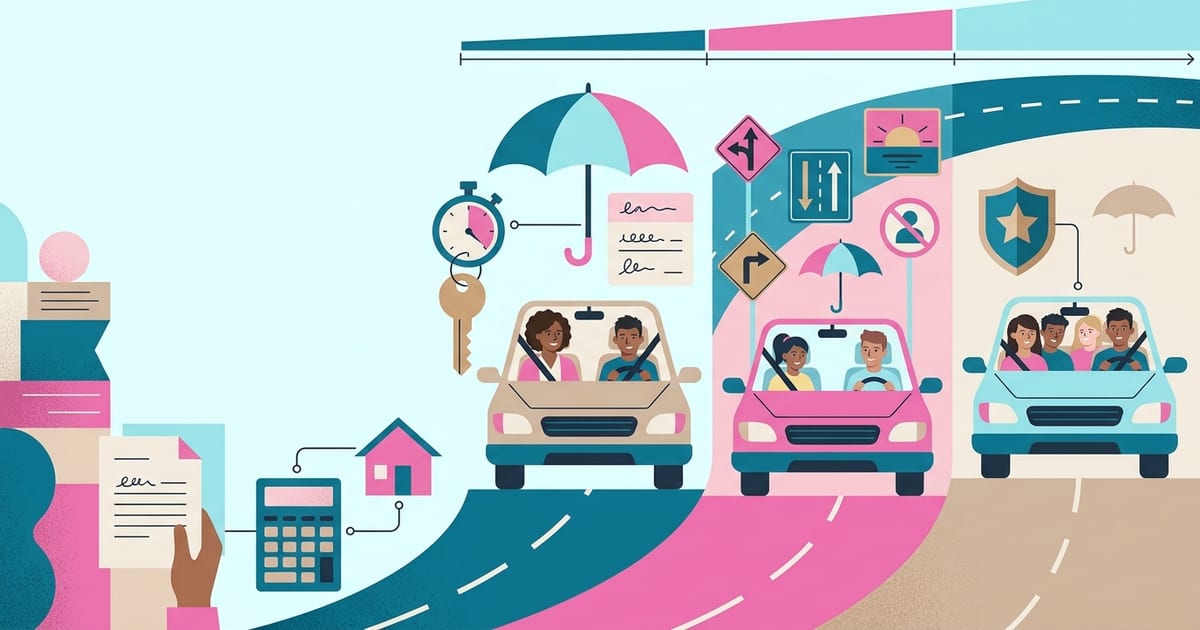
The three stages
| Stage | Typical rules | Insurance |
|---|---|---|
| Learner's permit | Supervised driving only; minimum hours logged | Usually covered automatically on family policy |
| Intermediate / provisional | Unsupervised; night curfew; passenger limits; no phone | Must be added as a rated driver |
| Full licence | No restrictions (often 17–18) | Rated as young driver; inexperience factor continues ~3 years |
Why the restrictions matter to insurers
Research on graduated licensing shows that night-driving curfews and passenger limits reduce fatal crashes among 16-year-olds significantly. Insurers benefit from the lower risk and some offer programmes that reinforce the rules—telematics with night-driving alerts, for example. Families that enforce the restrictions beyond the legal minimum tend to see both fewer incidents and better telematics scores.
Violations during the intermediate stage
Many states extend the intermediate period or suspend the licence for violations at this stage, and insurers surcharge the conviction for three years. The first accident or ticket guide covers what to expect.
Questions & answers
Is my teen covered with a learner's permit?
Usually yes, automatically, on the family policy. Confirm with your insurer.
When do I have to add my teen?
When they receive their intermediate (unsupervised) licence.
Do licence restrictions lower insurance?
Not directly as a discount, but they reduce crash risk, and telematics programmes reward the same behaviours.
Terms used in this guide
- Graduated driver licensing (GDL)
- The staged system—permit, intermediate, full—by which states license new drivers, with night and passenger restrictions at the intermediate stage.
- Intermediate (provisional) licence
- The GDL stage allowing unsupervised driving with restrictions. The teen must be added to the policy at this stage.
- Permissive use
- Coverage for an unlisted driver using your car with permission. Does not extend to household members who drive regularly—they must be listed.
Sources and references
Legal figures on this page (minimum limits, filing periods, statutory benefits) are checked against the primary law or the state insurance regulator listed below. Links and figures last verified Nov 2026.
- Teenagers — Insurance Institute for Highway SafetyIndependent researchTeen crash risk, graduated driver licensing research and vehicle recommendations for young drivers.
- Graduated licensing laws by state — Insurance Institute for Highway SafetyIndependent researchState-by-state learner, intermediate and full-licence ages, night-driving and passenger restrictions.
- Facts + Statistics: Teen drivers — Insurance Information InstituteStatistical dataCrash and fatality statistics for drivers 16–19 and graduated licensing context.
- Fatality facts: Teenagers — Insurance Institute for Highway Safety (2024)Statistical dataFatal crash rate per mile driven for 16–19-year-olds is just over 3 times the rate for drivers 20 and older (2022 travel data); all-severity crash rate is over 4 times; risk is highest at 16–17.
- Drivers in fatal motor vehicle crashes by age, 2023 — Insurance Information Institute (2025)Statistical dataFatal-crash involvement per 100,000 licensed drivers: 42.40 (16–20), 35.34 (21–24), 28.97 (25–34), 24.18 (35–44), 21.70 (45–54), 19.45 (55–64), 15.44 (65–74), 16.63 (75+).
- Auto insurance for teen drivers — Insurance Information InstituteConsumer guidanceAdding a teen to a parent's policy versus a separate policy; good-student and driver-training discounts; vehicle choice.
Practical guidance on this page is original editorial work. Cited sources support factual statements and do not endorse this site. Dollar ranges described as typical or illustrative are editorial estimates, not figures from these sources.
Guide
Adding a Teen Driver to Your Car Insurance
When you must add a teen, how permits are handled, how insurers assign teens to vehicles, named-driver exclusions, and the questions to ask your insurer.
Guide
A Teen's First Accident or Ticket
What happens to a family premium after a teen's first at-fault accident or ticket, how long it lasts, accident forgiveness, and what to do.
Guide
How Much It Costs to Insure a Teen Driver
What adding a 16- or 17-year-old does to a family premium, what a teen pays alone, why teens are the most expensive drivers to insure, and how the cost falls.