Entry in Car Insurance Discounts for Teen Drivers
Telematics and Usage-Based Insurance for Teen Drivers: Pros, Cons, and Savings
Learn how usage-based telematics programs track teen driving habits, what data insurers collect, how discounts apply, and when enrolling makes sense.

By Samuel Oduya · Staff Writer
Published
Answer in brief
Telematics programs track driving metrics such as hard braking, rapid acceleration, mileage, and nighttime driving through mobile apps or plug-in devices to adjust insurance rates. For families with teen drivers—who face fatal crash involvement rates of 42.40 per 100,000 licensed drivers according to the Insurance Information Institute—demonstrating safe habits can help offset substantial youthful operator premiums. Reviewing how your insurer prices driving behavior helps you decide whether enrolling your teen makes financial sense.
How Usage-Based Telematics Programs Evaluate Young Drivers
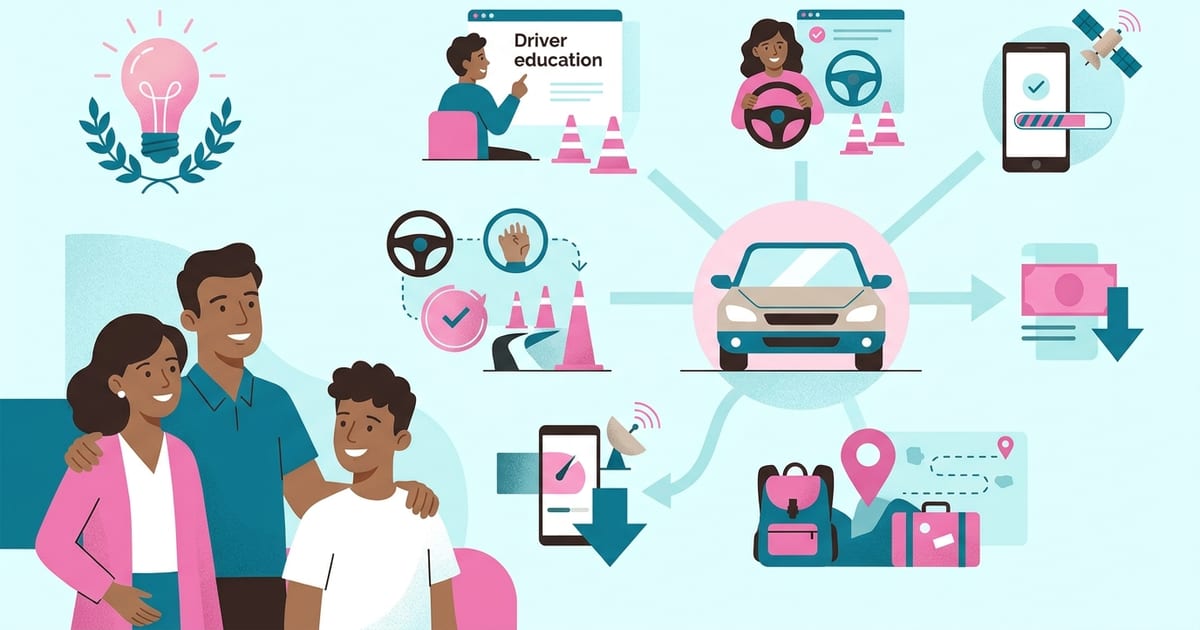
Telematics programs, commonly known as usage-based insurance (UBI) or pay-as-you-drive coverage, use smartphone applications or small diagnostic port devices to record actual driving behaviors. Rather than relying solely on traditional actuarial rating categories like age and zip code, insurers use telematics to calculate premiums based on real-world vehicle operation. For households insuring a teenager, this technology presents a unique opportunity to demonstrate lower individual risk.
Actuarial data compiled by the Insurance Institute for Highway Safety reveals that the fatal crash rate per mile driven for 16- to 19-year-olds is just over three times higher than for drivers aged 20 and older, while their all-severity crash rate is more than four times higher. Furthermore, Insurance Information Institute data shows that drivers aged 16 to 20 had a fatal crash involvement rate of 42.40 per 100,000 licensed drivers in 2023—the highest of any demographic. Because of this baseline statistical risk, adding a youthful operator to an existing policy triggers steep premium increases. Enrolling in a telematics program allows responsible young drivers to verify that their personal habits differ from overall age-group statistics.
Key Driving Behaviors Insurers Track Through Telematics
According to the Insurance Institute for Highway Safety, excessive speed increases both the likelihood of crashing and the severity of crash outcomes by lengthening the distance needed to stop. Telematics sensors flag rapid acceleration and harsh braking as primary risk indicators because they suggest aggressive maneuvering or delayed reactions. Similarly, late-night driving represents disproportionate danger for new motorists, which is why state graduated driver licensing frameworks universally restrict overnight operation.
Steps to Implement a Telematics Program With Your Teen
- 1
Evaluate program rating rules
Ask your insurer whether the telematics program is discount-only or if poor driving scores can trigger a surcharge at policy renewal.
- 2
Install the application or hardware
Download the insurer's tracking app on the teen's phone or plug the proprietary sensor into the vehicle's diagnostic port.
- 3
Establish family driving rules
Set clear boundaries regarding late-night trips, highway speeds, and mobile phone handling while driving to align with tracking metrics.
- 4
Review weekly scorecards together
Use the telematics dashboard to examine flagged driving events, such as hard stops or late trips, treating feedback as a coaching mechanism.
State Regulations and Pricing Protections
State insurance regulators closely supervise how auto insurers use telematics technology and customer driving data. The Insurance Information Institute notes that while most insurers offer introductory participation discounts simply for enrolling, states place varying boundaries on how usage-based metrics influence final rates upon policy renewal. Regulatory oversight from state insurance departments ensures that monitoring programs remain transparent and that pricing methodologies comply with established consumer protection standards.
Underlying state laws also govern which traditional rating factors insurers may combine with telematics data. For example, rating based on territory or zip code is prohibited in California and Michigan, while gender-based rating is prohibited in seven states. Where traditional rating variables are restricted, usage-based metrics provide insurers with alternative, performance-based pricing indicators.
Balancing Telematics With Other Cost-Reduction Strategies
According to the National Association of Insurance Commissioners, the countrywide average expenditure for auto insurance reached $1,281 in 2023, representing an increase of 13.98% over the previous year. For families adding a teen, managing this overall expense requires layering multiple cost-saving measures alongside usage-based monitoring.
| Savings Strategy | Typical Mechanism | Potential Savings Impact | Key Considerations |
|---|---|---|---|
| Telematics / Usage-Based | Tracks real-time speed, braking, and driving hours | Variable percentage discount | Requires active tracking and adherence to safe driving habits |
| Good Student Discount | Requires maintaining a 3.0 GPA (B average) or higher | Direct discount on youthful operator premium | Requires periodic report card or transcript submission |
| Raising Deductibles | Increasing physical damage deductible from $200 to $500 or $1,000 | Cuts collision/comprehensive cost 15% to 40%+ | Requires sufficient emergency funds to cover higher out-of-pocket costs |
| Multi-Policy Bundling | Combining auto policy with homeowners or renters coverage | Percentage reduction across combined policies | Requires maintaining multiple lines of coverage with one carrier |
The Insurance Information Institute notes that raising your deductible from $200 to $500 can cut your collision and comprehensive premium by 15% to 30%, while increasing it to $1,000 can save 40% or more. Pairing telematics participation with a good student discount and adjusted deductibles allows households to substantially moderate the total expense of insuring a new driver without sacrificing essential liability protection.
Questions & answers
Can a telematics device increase my teen's insurance premium?
Yes, depending on the specific program. While some insurers guarantee that telematics data will only be used to earn discounts, other carriers adjust rates upward if the data reveals repeated hard braking, high speeds, or excessive nighttime driving. Check your insurer's terms before enrolling.
Does telematics track where my teen drives?
Most telematics mobile applications collect GPS location data to verify trip routes and determine whether driving occurs on local streets or highways, though pricing calculations primarily rely on speed, braking, time of day, and total mileage.
How long must my teen use the tracking app or device?
Program lengths vary by carrier. Some insurers require tracking for a single introductory period (such as 90 days) to establish a permanent discount, whereas other programs require continuous monitoring to maintain the rate adjustment across renewal periods.
What happens if the app logs trips when my teen is a passenger?
Most telematics apps allow the user to review logged trips and change the driver status to passenger within a specified window, ensuring that another person's driving habits do not affect your family's insurance score.
Terms: Telematics (usage-based insurance), Youthful operator, Deductible, Good student discount, Graduated driver licensing (GDL)
Sources and references
Legal figures on this page (minimum limits, filing periods, statutory benefits) are checked against the primary law or the state insurance regulator listed below. Links and figures last verified Nov 2026.
- Background on: Pay-as-you-drive auto insurance (telematics) — Insurance Information InstituteIndependent researchUsage-based and per-mile pricing models, what telematics programmes measure, and state limits on their use.
- Teenagers — Insurance Institute for Highway SafetyIndependent researchTeen crash risk, graduated driver licensing research and vehicle recommendations for young drivers.
- Speed — Insurance Institute for Highway SafetyIndependent researchHow speed raises crash likelihood and severity; speed-limit and enforcement research.
- Graduated licensing laws by state — Insurance Institute for Highway SafetyIndependent researchState-by-state learner, intermediate and full-licence ages, night-driving and passenger restrictions.
- Fatality facts: Teenagers — Insurance Institute for Highway Safety (2024)Statistical dataFatal crash rate per mile driven for 16–19-year-olds is just over 3 times the rate for drivers 20 and older (2022 travel data); all-severity crash rate is over 4 times; risk is highest at 16–17.
- Drivers in fatal motor vehicle crashes by age, 2023 — Insurance Information Institute (2025)Statistical dataFatal-crash involvement per 100,000 licensed drivers: 42.40 (16–20), 35.34 (21–24), 28.97 (25–34), 24.18 (35–44), 21.70 (45–54), 19.45 (55–64), 15.44 (65–74), 16.63 (75+).
- 2019–2023 Auto Insurance Database: average premium supplement — National Association of Insurance Commissioners (2025)Statistical dataCountrywide average expenditure $1,281 in 2023 (+13.98%); combined average premium $1,438; state tables for liability, collision and comprehensive.
- Nine ways to lower your auto insurance costs — Insurance Information InstituteConsumer guidanceShop at least three quotes; raising a deductible from $200 to $500 can cut collision/comprehensive cost 15–30%, $1,000 can save 40%+; drop physical damage on cars worth under 10× the premium; bundling, low-mileage and good-student discounts.
Practical guidance on this page is original editorial work. Cited sources support factual statements and do not endorse this site. Dollar ranges described as typical or illustrative are editorial estimates, not figures from these sources.